
August 2026 Market Outlook
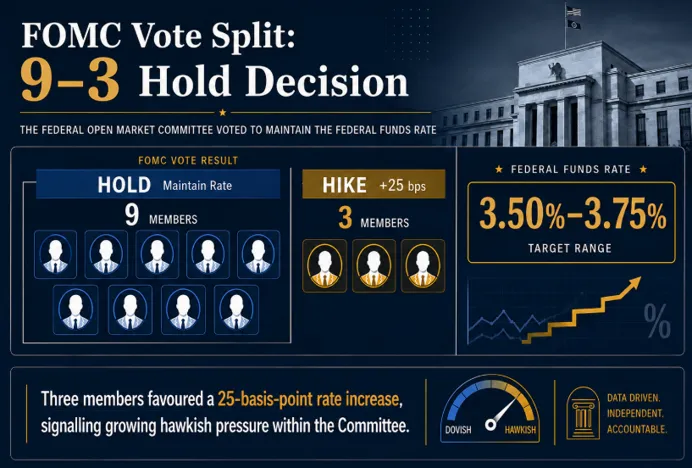
FOMC: Sharp Divisions over the Committee’s Policy Decision
The July FOMC meeting highlighted a sharp division among Committee members over the appropriate direction of monetary policy.
- Growing Dissent within the FOMC: The Committee voted 9–3 to maintain the federal funds rate at 50%–3.75%. Three members favoured a 25-basis-point rate increase, representing the largest same-direction dissent since September 2016, signalling growing hawkish pressure within the Committee.
- Persistent Inflationary Pressure: Core CPI remained elevated at 2.6% year-on-year, reinforced expectations that U.S. monetary policy could remain higher-for-longer.
The widening policy divide increased uncertainty surrounding the Fed’s future interest-rate path, contributing to a 2.56% decline in the Nasdaq Composite Index to 25,373.85 points during July. Prolonged monetary-policy uncertainty may encourage investors to reduce their exposure to rate-sensitive U.S. assets and reallocate capital towards emerging markets offering stronger growth prospects and more attractive.
Malaysian Capital Markets: Domestic Resilience Defies Global Volatility
Malaysia’s financial markets demonstrated relative resilience despite a weaker and volatile global environment.
- Hawkish Tone from the U.S. Federal Reserve: Three policymakers voted in favour of a 25-basis-point rate increase, signalling a more hawkish policy stance and raising the possibility that U.S. interest rates could remain higher-for-longer.
- Stronger Economic Growth: Malaysia’s advance gross domestic product estimate showed that the economy expanded by 5.8% year-on-year in the second quarter of 2026, improving from 5.4% in the first quarter 2026.
- Stable Monetary Conditions: Headline inflation moderated to 1.9% in June, while Bank Negara Malaysia maintained the Overnight Policy Rate at 2.75%, providing a relatively stable domestic monetary environment.
The combination of stronger economic activity, moderate inflation and net cash inflow to Malaysia provided a constructive backdrop for Malaysian assets. The FBM KLCI advanced approximately 3.66% to 1,724.90 points in July
Real Estate Focus: Malaysia’s Data-Centre Growth Shifts toward Sustainability
The development of Malaysia’s data-centre sector continued to gain momentum in July. Johor’s data-centre capacity is expected to expand towards 7,000 megawatts, further strengthening the state’s position as one of Southeast Asia’s leading digital-infrastructure hubs. The growth will increasingly depend on access to reliable power, efficient water management, renewable-energy integration and continued acceptance from local communities.
- Stricter Development Standards: New data-centre projects are facing greater scrutiny over the reliability of electricity supply, the efficiency of cooling systems, water consumption, environmental impact and their broader contribution to the local economy.
- Flight to Quality: Locations with secured grid capacity, energy-efficient cooling systems, renewable-energy arrangements and the necessary planning approvals are likely to attract stronger investor interest .
- Property Spillover: Sustainable data-centre development could continue to support demand for modern industrial facilities, logistics assets, utility infrastructure and professionally managed commercial properties, particularly in Johor and selected locations across Greater Kuala Lumpur.
The policy transition does not represent a rejection of digital-infrastructure investment. Instead, it reinforces the importance of asset quality, ESG credentials and responsible long-term project execution.
Johor–Singapore Special Economic Zone: Advancing Towards Commercial Activation
Johor continued to strengthen its international investment pipeline in July through a high-level investment mission from China, primarily focused on the JS-SEZ investment framework and industrial ecosystem. Investment roundtable and targeted one-on-one meetings involving Chinese and Malaysian banks attracted more than 150 representatives from businesses, investors and financial institutions.
- Stronger Investment Pipeline: Direct engaged with prospective investors supported the development of potential investments in high-value manufacturing and related service activities within the JS-SEZ.
- Supply-Chain Expansion: Engagement with downstream customers and business partners aimed to attract complementary investments, thereby increase demand for specialised manufacturing facilities, supplier premises, warehouses and logistics space.
- Implementation Support: The participation of utility providers, infrastructure companies and investment-facilitation agencies strengthened the practical support available for project implementation. This could accelerate the formation of integrated manufacturing clusters and generate additional demand for industrial facilities, logistics infrastructure and worker accommodation within the JS-SEZ.
Industrial land and commercial assets supported by reliable utilities, established logistics networks, skilled labour and identifiable occupier demand are well positioned to benefit from the JS-SEZ’s continued development. This reinforcing expectations of outperformance in Johor’s industrial and commercial property segments.
Summary & Investment Strategy
July 2026 was shaped by growing divisions within the Federal Reserve and persistent inflationary pressure, reinforcing expectations that U.S. interest rates could remain higher for longer. The resulting policy uncertainty weighed on rate-sensitive assets and encouraged investors to reallocate capital towards emerging markets offering stronger growth prospects and more attractive valuations.
For Malaysia, stronger economic growth, moderate inflation and stable monetary conditions continued to support domestic market resilience. The Malaysia’s equity and real estate markets remain constructive, with a preference for industrial, logistics and digital-infrastructure-linked assets. The continued expansion of data centres and progress within the JS-SEZ are expected to strengthen occupier demand, support long-term property values and enhance the investment appeal of well-located industrial and commercial assets.
Disclaimer
The information contained herein does not constitute an offer, invitation or solicitation to invest in Asia Vision Capital (“AVC”)). This article has been reviewed and endorsed by the Chief Investment Officer (CIO) of AVC. This article has not been reviewed by The Securities Commission Malaysia (SC). No part of this document may be circulated or reproduced without prior permission of AVC. This is not a collective investment scheme / unit trust fund. Any investment product or service offered by AVC is not obligations of, deposits in or guaranteed by AVC. Past performance is not necessarily indicative of future returns. Investments are subject to investment risks, including the possible loss of the principal amount invested. Investors should note that the value of the investment may rise as well as decline. If investors are in any doubt about any feature or nature of the investment, they should consult AVC to obtain further information including on the fees and charges involved before investing or seek other professional advice for their specific investment needs or financial situations. Whilst we have taken all reasonable care to ensure that the information contained in this publication is accurate, it does not guarantee the accuracy or completeness of this publication. Any information, opinion and views contained herein are subject to change without notice. We have not given any consideration to and have not made any investigation on your investment objectives, financial situation or your particular needs. Accordingly, no warranty whatsoever is given and no liability whatsoever is accepted for any loss arising whether directly or indirectly as a result of any persons acting on such information and advice.